Newsletter Subscribe
Enter your email address below and subscribe to our newsletter

Enter your email address below and subscribe to our newsletter
Learn, Tech & AI
 ByUpkar
AdSense Arbitrage idea sounds straightforward—pay for cheap traffic, send it to your site, and earn more from Google AdSense ads than you spent. But in 2026, it’s not the easy side hustle many expect. Google’s algorithms are smarter than ever at detecting low-value content and bot traffic.
Reality hit hard when AdSense account gets flagged for “invalid traffic,” and profit margins evaporated faster than the ad budget. This painful lesson makes you look for how to earn money using AdSense arbitrage for beginners the right way—through careful planning, policy compliance, and realistic expectations.
In this pillar guide, I’ll walk you through the entire journey: what AdSense arbitrage is, the safest way to set it up, how to calculate profits, the risks (including account bans), and whether it’s a smart move in 2026—especially for readers searching from India.
Prefer to watch instead of read? Check out our quick explained video on how to earn using AdSense Arbitrage in 2026 for beginners.
AdSense arbitrage is the practice of buying traffic from advertising platforms (like Facebook Ads, native ad networks, Taboola, Revcontent or Google Ads) and monetizing that traffic through Google AdSense, aiming to earn more from ad revenue than you spend on acquiring visitors.
If you’ve been searching for ways to monetize a website without creating viral content or building a massive social following, AdSense arbitrage has probably come up. The idea sounds almost too simple: buy cheap traffic, earn more from AdSense ads than you spent, keep the difference.
Traffic arbitrage = Revenue from ads > Cost of traffic
Here’s a basic example:
Sounds straightforward, right? The reality involves dozens of variables: your AdSense RPM (revenue per thousand impressions), click-through rates, traffic quality, content relevance, niche selection, and Google’s increasingly strict policies.
Why people attempt AdSense arbitrage:
Why many fail:
According to discussions on Reddit’s PPC community, successful arbitrage requires sophisticated tracking, constant optimization, and understanding of both paid traffic and AdSense mechanics.
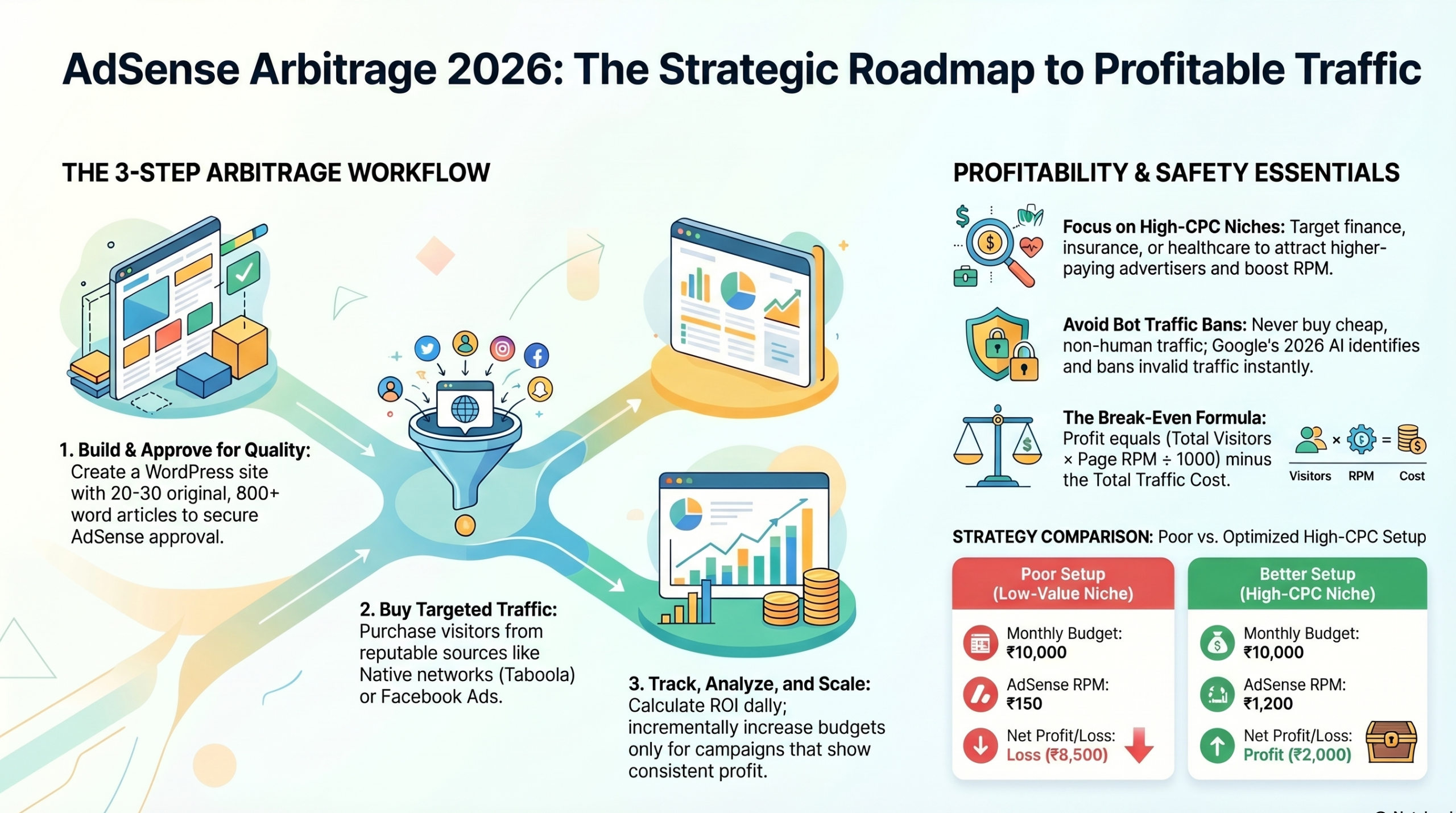
Let me break down the adsense arbitrage strategy 2026 process so you understand the complete workflow:
You need a website with genuine, valuable content. This isn’t optional—it’s mandatory for AdSense approval and long-term success.
Requirements:
Choose a niche with high AdSense CPC (cost per click). High CPC niches in India include finance, insurance, legal services, education, and healthcare. However, these also have higher traffic costs.
Apply for Google AdSense only after your website meets quality standards.
AdSense approval tips for beginners:
AdSense approval in 2026 has become stricter. Google wants to see established websites with genuine audiences, not sites built solely for arbitrage.
Once approved, strategically place ads to maximize revenue without violating policies.
Best practices:
According to ClickAdu’s AdSense arbitrage guide, ad placement can impact RPM by 200-300%. The same traffic can generate vastly different revenue based on placement alone.
Not all content performs equally for arbitrage. You need content that:
Content for adsense arbitrage should be:
The goal is high engagement time and multiple page views per visitor, which increases ad impressions.
This is where arbitrage happens. You purchase traffic from advertising platforms.
Traffic sources (covered in detail later):
Start with small budgets—₹500-₹1,000—to test before scaling.
This separates profitable arbitrageurs from those who lose money.
Track these metrics:
The critical formula:
Profit = (Visitors × Page RPM / 1000) – Traffic Cost
If you’re spending ₹1 per click and your page RPM is ₹600, you need at least 1.67 page views per visitor just to break even. This is why engagement metrics matter enormously.
Once you identify profitable traffic sources and content combinations:
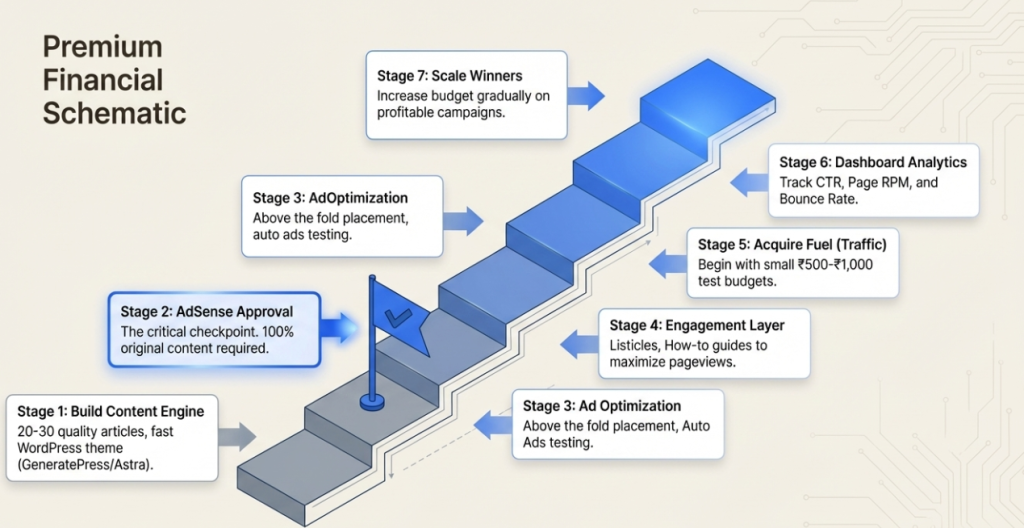
Yes, it is completely legal. There are no laws against buying traffic to your website. However, “legal” does not mean “Google approves of everything.”
Google has strict policies against MFA (Made for AdSense) sites. If your website is just a thin shell of a page with five sentences and ten ads, Google will ban your account for policy violations. You must provide genuine value to the reader. Your traffic must also be real. Buying fake bot traffic from Fiverr is the fastest way to permanently lose your AdSense account.
Google’s machine learning systems in 2026 are sophisticated at detecting low-quality arbitrage attempts. They’re looking for:
Buying traffic and monetizing it through AdSense is not inherently illegal or against Google’s policies — as long as:
Focus on quality:
Be transparent:
Monitor your metrics:
I’ve seen AdSense accounts banned not because arbitrage itself violated policies, but because the traffic quality was poor or the promotion was deceptive.
Best countries for adsense arbitrage traffic:
While you can operate from India, targeting traffic from high-CPC countries (USA, UK, Canada, Australia) typically generates better AdSense rates. However, this also means higher traffic costs.
Indian traffic generally has lower CPC rates but also costs less to acquire. The margins can still work with proper optimization.
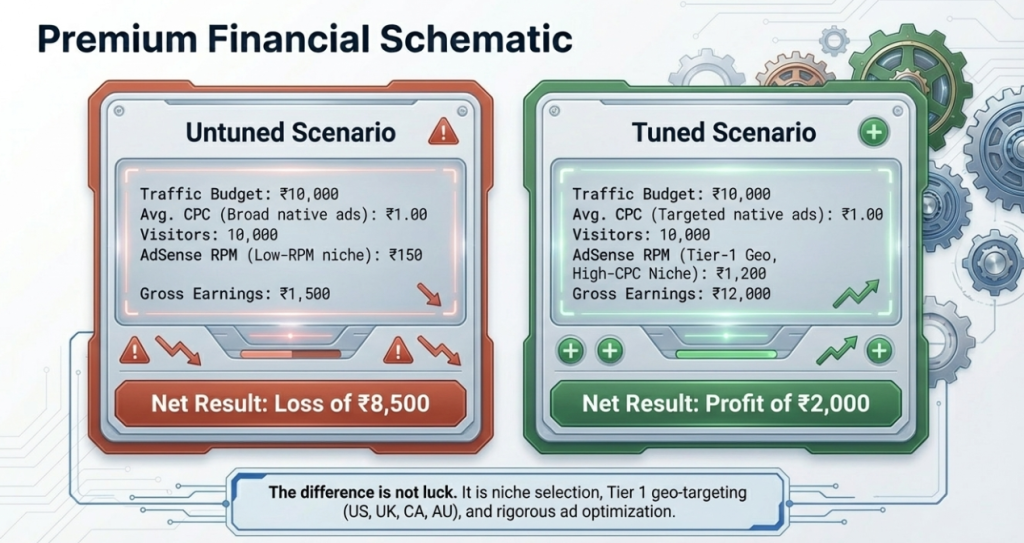
Let’s work through a realistic example so you understand the actual math.
Scenario: A beginner starts with ₹10,000/month traffic budget
| Metric | Value |
|---|---|
| Monthly traffic budget | ₹10,000 |
| Avg. cost per click (native ads) | ₹1.00 |
| Visitors purchased | 10,000 |
| AdSense RPM (revenue per 1,000 visitors) | ₹150 |
| Gross AdSense earnings | ₹1,500 |
| Net result | Loss of ₹8,500 |
That’s what happens with poor targeting, low-quality content, and a low-RPM niche. Now here’s the same budget with a better setup:
| Metric | Value |
|---|---|
| Monthly traffic budget | ₹10,000 |
| Avg. cost per click (targeted native) | ₹1.00 |
| Visitors purchased | 10,000 |
| AdSense RPM (high-CPC niche, Tier 1 geo targeting) | ₹1,200 |
| Gross AdSense earnings | ₹12,000 |
| Net profit | ₹2,000 |
The difference isn’t luck. It’s niche selection, geo-targeting (sending traffic from high-CPC countries like the US even if your audience is global), and ad optimization.
Key variables that determine profitability:
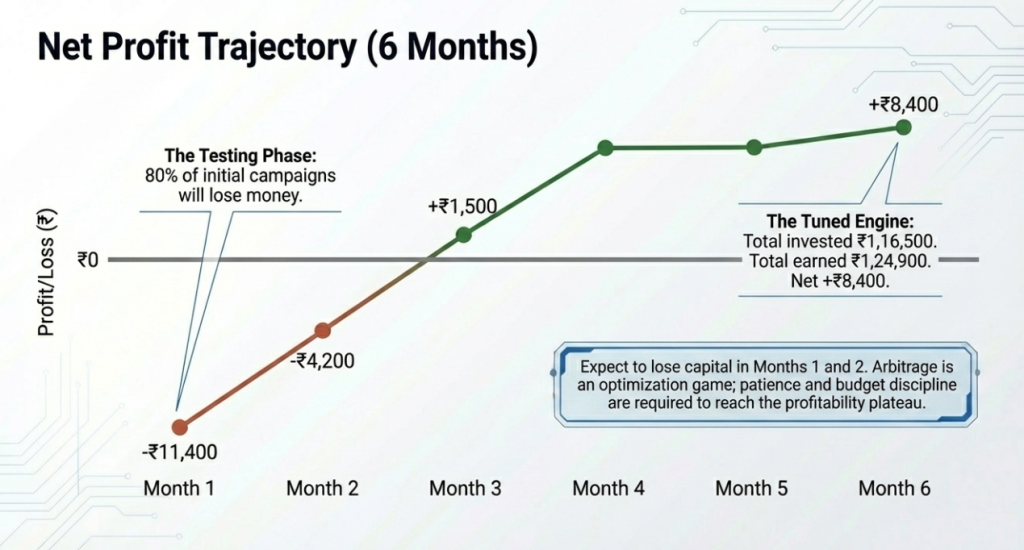
Most beginners break even or lose money in months 1–2. Those who stick with it and optimize usually find their margin by month 3 or 4.
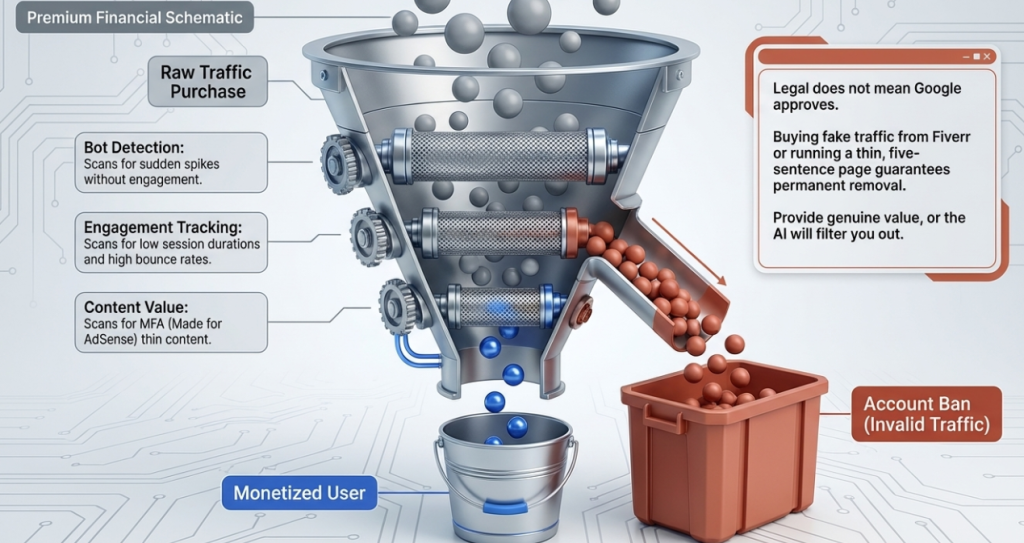
Focus here or you’ll almost certainly lose money. Top performing niches right now include:
These attract advertisers who bid higher. Indian traffic in finance can deliver better RPM than generic entertainment topics, but it still usually runs lower than Tier-1 countries like the US.
Not all traffic sources work equally well for AdSense arbitrage. Some are too expensive, others violate AdSense policies, and many deliver low-quality visitors.
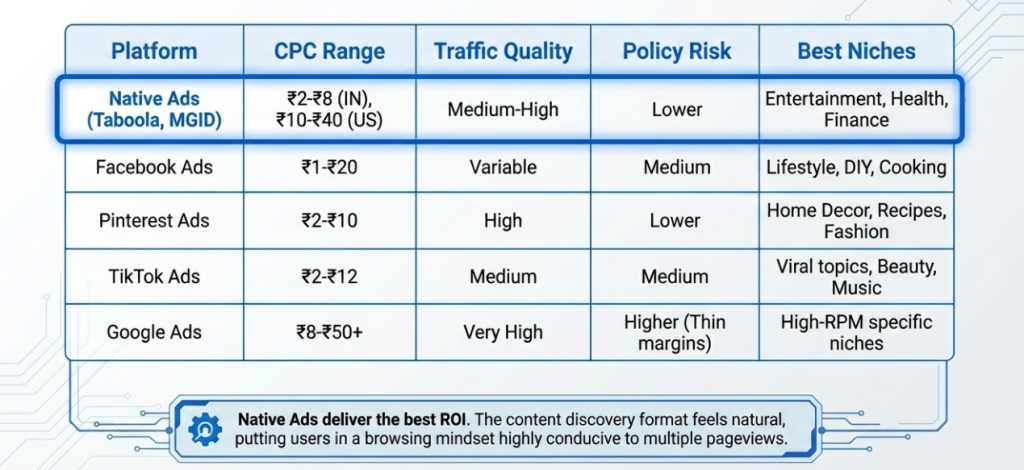
Here’s our breakdown of best traffic sources for adsense arbitrage in 2026:
Platforms: Taboola, Outbrain, MGID, RevContent
Why they work:
Pros:
Cons:
Cost: CPC typically ₹2-₹8 for Indian traffic, ₹10-₹40 for US/UK traffic
Best for: Entertainment, health, finance, lifestyle content
Native ads consistently deliver the best ROI for content-based arbitrage when properly optimized.
Why they work:
Pros:
Cons:
Cost: CPC typically ₹1-₹5 for Indian audiences, ₹5-₹20 for Western audiences
Best for: Lifestyle, entertainment, DIY, cooking, health topics
Use engaging images, ask questions in ad copy, and target specific interest groups, not broad audiences.
Why they work:
Pros:
Cons:
Cost: CPC typically ₹2-₹10 depending on niche
Best for: Home decor, recipes, DIY, fashion, health, parenting
Why it’s complicated:
Google technically allows AdSense on sites that receive traffic from Google Ads, but there are strict policies.
The challenge:
You’re essentially paying Google to drive traffic to earn back from Google. The margins are extremely thin, and Google scrutinizes these arrangements.
When it works:
Pros:
Cons:
Cost: CPC typically ₹8-₹50+ depending on keywords
Best for: Advanced arbitrageurs only, specific high-RPM niches
Why it’s growing:
TikTok’s advertising platform has matured, offering lower CPCs than Facebook in many categories.
Pros:
Cons:
Cost: CPC typically ₹2-₹12
Best for: Entertainment, music, beauty, fitness, trending topics
These will likely get your AdSense account banned:
These sources violate AdSense policies and will trigger invalid traffic flags.
Native Ads vs Google Ads for AdSense arbitrage:
| Factor | Native Ads | Google Ads |
|---|---|---|
| CPC | ₹2-₹8 (moderate) | ₹8-₹50+ (high) |
| Quality | Medium-High | Very High |
| Engagement | Good | Excellent |
| Profit Margin | Better | Very tight |
| Ease of Use | Moderate | Complex |
| Policy Risk | Lower | Higher |
| Best for | Content discovery | Intent-based searches |
For beginners, native advertising networks offer the best balance of cost, quality, and profitability.
If you’re starting with ₹5,000–₹15,000/month, here’s a realistic roadmap:
Set up a WordPress site. Use a lightweight, fast theme — GeneratePress or Astra are popular choices for AdSense sites because they load quickly and have clean ad placement zones.
Publish 20–30 original articles of at least 800–1,000 words each. Focus on evergreen topics in categories like health tips, personal finance basics, or how-to content. Avoid news content initially — it’s harder to sustain and has variable traffic value.
Apply for AdSense only after your site looks like a real publication. A site with 5 thin articles won’t get approved.
Start with ₹2,000–₹3,000 on MGID or Revcontent targeting Tier 1 countries (even if your site is in English with a global audience). Run 5–7 different article titles as ad creatives and see which CTR performs best.
Track your AdSense RPM against traffic cost daily. Don’t scale anything that isn’t at least breaking even.
Once you’ve found 2–3 articles that generate profitable RPMs, increase budget on those campaigns, test new content topics in the same niche, and begin refining your ad layout for maximum viewability.
This is also when many beginners look at adding a second revenue stream (Ezoic, Mediavine if eligible, or direct ad sales) to increase RPM without changing traffic cost.
These are the patterns that reliably end arbitrage experiments early:
1. Buying traffic before having AdSense approval Buying traffic to a site without AdSense live means you’re spending with zero return. Get approval first, verify ads are serving, then start traffic.
2. Targeting cheap traffic from Tier 3 countries to boost volume A million visitors from low-CPC markets won’t pay your bills. RPM from Tier 3 traffic can be ₹10–₹30. You need Tier 1 or Tier 2 traffic to make the math work.
3. Ignoring page speed If your site takes 5 seconds to load, visitors bounce before ads render. AdSense can’t earn you money from an impression it never got. Use Google PageSpeed Insights and fix your Core Web Vitals before running paid traffic.
4. Copying content from other sites This will get your AdSense application rejected, and if somehow approved, the duplicate content will fail to rank organically and will generate thin engagement signals that flag your account. Read the AdSense policy violations list thoroughly. Check policy updates regularly.
5. Scaling losers Too many beginners increase traffic spend on campaigns that are barely breaking even, hoping volume will fix a broken margin. It won’t. Fix the RPM problem first (better content, better niche, better ad placement), then scale.
6. Putting all AdSense revenue eggs in one basket If your AdSense account gets suspended — and it can, even for legitimate publishers — your entire business evaporates overnight. Diversify revenue streams as early as possible.
Arbitrage can generate cash faster if everything clicks. Affiliate marketing builds slower but more stable income and faces fewer ban risks because you’re not relying solely on display ads. Many experienced publishers combine both—using arbitrage traffic to test offers and then nurturing those visitors with email lists or better content.
| Factor | AdSense Arbitrage | Affiliate Marketing |
|---|---|---|
| Difficulty | Medium | Hard |
| Earnings per visitor | ₹1-₹4 | ₹40-₹400+ |
| Traffic volume needed | Very high | Lower |
| Conversion required | No | Yes |
| Profit margins | 10-40% | 50-500%+ |
| Risk | Account bans | Merchant issues |
| Sustainability | Medium | Higher |
| Scalability | Limited | Significant |
Let me share an adsense arbitrage case study beginner approach that represents realistic expectations:
Investment:
Results:
Investment:
Results:
Investment:
Results:
Average monthly investment:
Average monthly results:
ROI: 20-40% monthly
Total invested: ₹1,16,500
Total earned: ₹1,24,900
Net profit: ₹8,400 over 6 months
Average monthly profit (months 3-6): ₹6,975
This is realistic for a beginner putting in consistent effort. Not getting rich, but building a foundation for scaling.
Once you’ve found a profitable margin on a small budget, scaling is straightforward in theory but requires discipline:
Increase traffic spend incrementally — don’t jump from ₹500/day to ₹5,000/day overnight. Algorithms at native ad networks optimize over time; sudden budget jumps can temporarily spike your CPC.
Add more content in your profitable niche — more articles means more campaigns to run traffic to, which reduces dependence on any single page.
Test new traffic sources — if Taboola is working, test Outbrain. If MGID is profitable, try Revcontent. Diversified traffic sources reduce platform risk.
Increase RPM through ad optimization — test different ad sizes, placements, and density (within policy limits). Some publishers see 20–40% RPM lifts just from placement changes.
Consider Ezoic as a complement — Ezoic’s ad optimization platform can increase RPM significantly for sites that qualify, without requiring you to manually manage ad placements
The honest answer to is adsense arbitrage profitable in 2026: Yes, but it’s harder than ever and not for everyone.
Why it’s harder in 2026:
Who can still profit:
Who will struggle:
Our honest assessment:
AdSense arbitrage in 2026 is a viable side income or small business for the right person, but it’s not a passive income dream or get-rich-quick scheme. Expect:
If you’re prepared for these realities, go for it. If you want easier money, consider other online business models.
AdSense arbitrage is a real monetization model and it can work in 2026. How to earn money using AdSense arbitrage for beginners isn’t a simple path, but it’s possible with the right approach.
Ready to start? Begin with a quality website, get AdSense approval, and test with ₹5,000-₹10,000. You’ll quickly learn if this business model fits your skills and temperament.
It’s harder than it was in 2018–2020 but still viable. RPMs have become more volatile, traffic source CPCs have risen, and AdSense’s automated invalid traffic detection has improved. Profitable operators today tend to focus on high-CPC niches, Tier 1 geo targeting, and multi-page content formats. Thin content arbitrage sites are largely dead.
Realistically, you need ₹10,000–₹20,000/month to run meaningful traffic tests. Some traffic networks like MGID and Revcontent accept smaller budgets ($50–$100). Below that, you won’t get enough data to optimize. Factor in website setup costs (domain, hosting, theme) of roughly ₹3,000–₹5,000 as a one-time expense.
Follow policies: avoid invalid traffic, don’t use misleading ad placement, keep content original and helpful, and don’t encourage clicks.
Yes—if you can focus on content quality, intent-based traffic, and disciplined testing. “Cheap clicks + thin pages” is where most beginners get burned.
United States, United Kingdom, Canada, Australia, and Germany consistently produce the highest AdSense RPM. Finance, health, legal, and insurance content from US visitors can command $10–$30+ RPM. Targeting these geos with native ad campaigns — even at slightly higher CPCs — almost always produces better margins than cheaper Tier 3 traffic.
If you’re serious about doing this the long-term way, save this guide and follow up with TechGuruShiksha for deeper topic clusters (traffic testing, content templates, and compliance checklists).
Bookmark this page and check back regularly for updates. Subscribe to our newsletter for detailed case studies, traffic source comparisons, and real profit/loss reports from active arbitrage campaigns.
Want to discuss strategies or share your own experiences? Join the conversation in the comments below. We respond to every genuine question.
Your next step: If you’re serious about AdSense arbitrage, start today with website setup. The sooner you begin building quality content and getting AdSense approval, the sooner you can start testing and learning.
Good luck with your arbitrage journey!