Newsletter Subscribe
Enter your email address below and subscribe to our newsletter

Enter your email address below and subscribe to our newsletter
Learn, Tech & AI

 ByUpkar
You download a new AI app. It’s brilliant. It writes a blog post in your voice, designs a logo, or summarizes a 50-page report in seconds. You use it religiously for a week, maybe even pay for a subscription. Then… silence. The app sits on your phone, unopened. The credit card keeps getting charged, but you’ve mentally moved on.
This isn’t your fault. It’s a systemic pattern plaguing the AI app ecosystem. Industry reports consistently show AI-powered applications excel at generating revenue—often through compelling freemium models and high initial conversion rates—but then face a steep cliff when it comes to long-term user engagement. The metrics look great in the first 30 days: strong activation, solid early monetization. The retention curves, however, tell a different story, often plummeting after the first month.
The core question isn’t if AI apps can make money. They clearly can. The urgent question is: Why do so many AI tools lose users so quickly after that initial traction? The answer lies not in the AI’s intelligence, but in fundamental product design, user habit formation, and a misunderstanding of what “value” really means in an AI context. Let’s dissect the AI apps retention problem.
If you’ve launched, invested in, or simply relied on an AI tool, this pattern probably feels familiar. The initial excitement is real. Then usage drops, the subscription feels optional, and churn kicks in. At TechGuruShiksha, we track AI tools daily while helping creators and learners pick the ones worth keeping. The gap between quick revenue and weak retention isn’t random—it points to deeper issues in how these products are built and experienced.
There’s a pattern quietly breaking AI startups in 2026.
This is not an edge case. It’s the defining challenge of the AI app era right now — why AI apps generate revenue but fail retention, and why the gap between those two things is wider than most founders expect.
RevenueCat’s 2026 State of Subscription Apps Report analyzed over a billion in-app transactions. The headline contrast is stark:
In short, AI drives stronger first purchases but struggles to prove ongoing value. Users cancel annual plans 30% faster, and the novelty often wears off before habits form.
Let’s be clear about one thing first: AI apps are genuinely strong at monetization. The numbers aren’t inflated.
AI apps convert users from trials to paid customers 52% better than non-AI apps, with median conversion rates of 8.5% compared with 5.6% for non-AI apps. They also monetise downloads about 20 per cent more effectively, recording a median rate of 2.4 per cent compared with 2 per cent for non-AI apps.
Monthly lifetime value is higher too. On a monthly basis, AI apps recorded a median realised lifetime value of $18.92 compared with $13.59 for non-AI apps.
So what’s the problem?
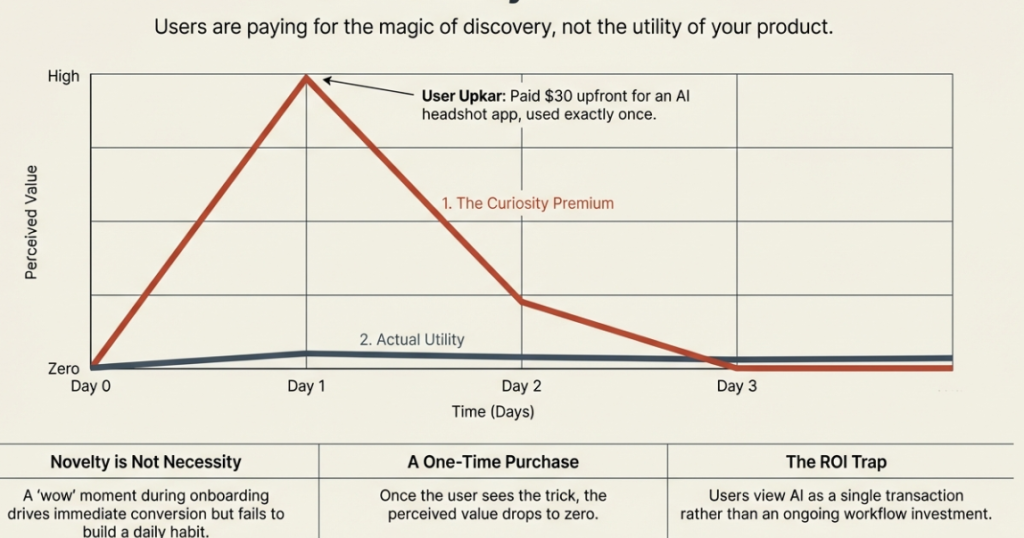
The problem is that all of this early performance is driven by novelty, not necessity. AI creates a “wow” moment in onboarding — something that feels genuinely impressive on first use. Users convert because the product is exciting, not because it’s indispensable. And there’s a big difference between those two things.
This article breaks down what’s actually driving that crack — and what can be done about it.
There isn’t one single failure point; AI SaaS retention challenges usually stack up in a chain. Here are a few common breakages:
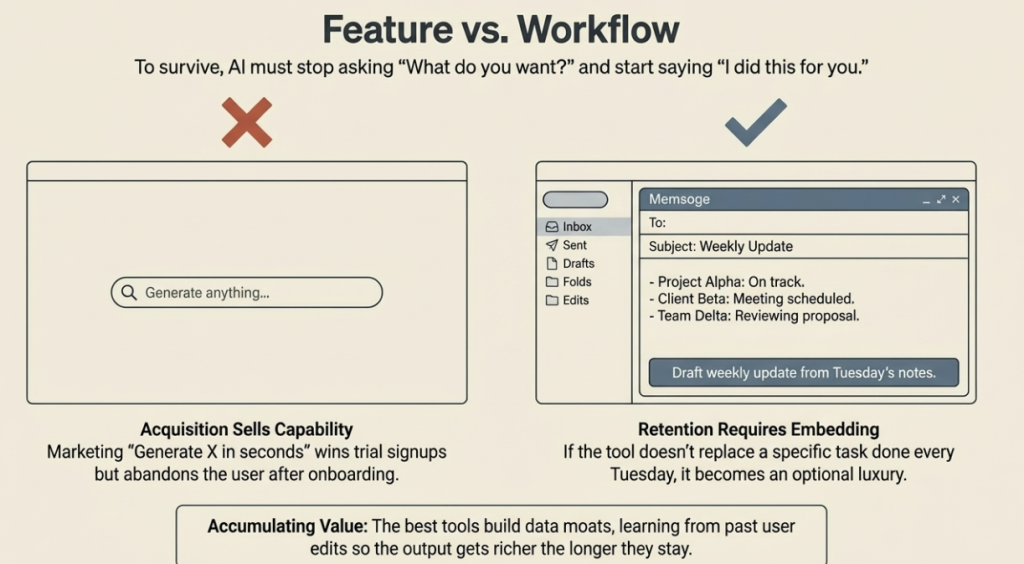
Most AI apps make the same mistake: they lead with capability. “Generate X in seconds.” “Summarize anything instantly.” “Create professional content with one click.”
That pitch works for acquisition. People are genuinely curious. They want to try it.
But curiosity is a one-time purchase. If the tool doesn’t fit into something the user does every week — a real recurring task, a genuine workflow problem — the “wow” fades fast. If the app doesn’t become embedded in a daily workflow, users hit a novelty cliff where the AI feels impressive but not essential.
The subscription keeps running. The user doesn’t.
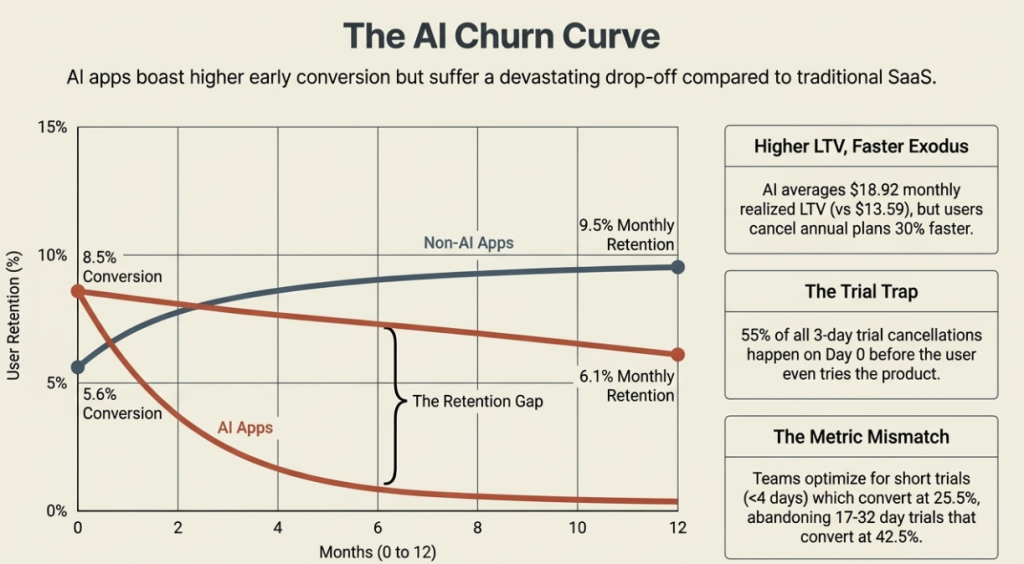
55% of all 3-day trial cancellations happen on Day 0. That’s a staggering number. More than half of all short-trial churns happen before the user even gives the product a real chance.
The instinct to use short trials — three days, sometimes less — is understandable. It looks good on week-one dashboards. But long-trial conversion: trials of 17–32 days convert at an incredibly high median of 42.5%, while short trial conversion: trials of fewer than 4 days convert at just 25.5%, meaning long trials convert roughly 70% better.
Despite that data, trials of fewer than 4 days rose from 42.1% in 2025 to 46.5% in 2026. Most teams are optimising for the short metric — conversion rate — while inadvertently making the long metric — retention — worse.
Here’s an uncomfortable truth that too many AI builders avoid: if your entire product is a thin interface wrapped around an LLM that anyone can access, your pricing is eventually going to face a serious question from paying users.
“Why am I paying $20/month for a wrapper?” If your app doesn’t add clear value beyond the model itself, retention will suffer. Creem
The AI tools that retain best are not the ones with the flashiest features at launch. They’re the ones that accumulate value over time — personalized outputs that improve with use, data that becomes richer the longer you stay, workflows that would be genuinely painful to rebuild elsewhere.
For productivity AI tools, the value must be continuous and measurable. A user might think, “I paid $20 and it saved me 2 hours once. That’s a good ROI.” Unlike a tool like Excel, where skill growth creates more value over time, many AI apps offer a flat, static utility. Once the core need is met, there’s little incentive to return, leading to AI apps losing users quickly.
TAI app onboarding issues are a primary AI tools user engagement issues. Here’s a difference between onboarding that impresses and onboarding that installs habits. Most AI apps do the first; almost none do the second.
Good onboarding should connect the product to the user’s actual recurring problem within the first session. Not just “here’s what the AI can do.” But “here’s how this replaces the thing you’re currently doing every Tuesday.”
The user is left to experiment, which is fun once, but not a sustainable workflow. Without a structured, personalized first experience that demonstrates immediate, repeatable value, users get stuck and leave.
The number of new subscription apps launching each month has grown 7X since 2022, creating a hyper-competitive environment where distribution, not just features, is the primary barrier to success.
Six major AI video models launched in Q1 2026 alone: Kling 3.0, Seedance 2.0, Pika 2.5, LTX-2, Veo 3.1, and Luma Ray3. Each requires a separate subscription. Users subscribe to the new thing, churn from the previous one, and repeat. The AI apps churn rate is partly a structural consequence of an oversaturated market where users feel little loyalty because switching costs are near zero.
Most AI apps follow a predictable pattern:
This explains how AI tools lose users after initial traction—they solve a problem once, not repeatedly.
Unlike social media or messaging apps, most AI tools lack habit loops. There’s no reason to come back daily.
The pattern for AI startups that don’t solve retention is predictable: strong launch, impressive early metrics, aggressive investor interest — followed by a slow-motion revenue bleed that doesn’t show up clearly until Month 6 or 7.
By then, the CAC (customer acquisition cost) looks worse in hindsight because the LTV (lifetime value) it was measured against was based on early retention assumptions that didn’t hold. The unit economics that looked solid at launch quietly collapse.
For investors, the data underscores the importance of scrutinizing retention metrics alongside growth. An AI startup boasting high conversion rates but hiding poor churn data may represent a significant risk.
This is the AI SaaS retention challenge that most pitch decks still don’t address honestly.
The good news is that AI product retention strategies can work when they shift away from shiny one-off features and toward durable usage patterns. Here are retention-focused adjustments that teams often under-apply:
These patterns are why AI apps can win rapid revenue but struggle with AI startup growth problems that stem from weak long-term user engagement.
Upkar told TechGuruShiksha:
Six months ago, I paid $30 upfront for an AI headshot generator. The marketing was brilliant, the promise was irresistible, and I handed over my credit card without a second thought. I uploaded my photos, got my generated images, and was genuinely impressed.
I haven’t opened the app since.
I’m the perfect example of the biggest paradox in tech right now: why AI apps generate revenue but fail retention.
Consumers are remarkably willing to open their wallets for artificial intelligence. We buy into the magic. But that magic is causing a massive blind spot for founders. Early monetization creates a false sense of product-market fit. Soon after the launch metrics cool off, companies are hitting a wall, watching users quietly cancel their plans and uninstall the software.
If you’re building in this space and watching your user base leak like a sieve, it’s time to stop looking at your top-line revenue and start looking at your daily active users. Let’s look at why users stop using AI apps and how you can shift from selling a parlor trick to building a daily necessity.
| Feature | Acquisition-Driven (High Churn) | Retention-Driven (High Stickiness) |
| Interface | Blank chat box | Role-specific templates & buttons |
| Value Prop | “Generate anything” | “Cut your email time in half” |
| Workflow | Standalone web app | Chrome extension / Deep integration |
| Data | Forgets user after session | Learns from past edits and choices |
AI app success versus long-term user engagement comes down to one question: Does this tool become quietly indispensable, or does it stay exciting for a week?
For founders and product teams, the retention vs acquisition AI balance matters more than ever. Heavy spending on growth only pays off when users stick around. For everyday users, it’s worth asking whether each new AI subscription actually saves more time than it costs in money and attention.
At TechGuruShiksha, we track these trends closely because the gap between “AI app that earns” and “AI app that lasts” is one of the most important strategic questions in the industry right now. Understanding it is the first step to doing something about it.
AI apps often experience a “curiosity spike” where users buy the app to test the technology rather than solve a recurring problem. Once the novelty wears off, users cancel their subscriptions.
The biggest issue is the “blank canvas” problem. Presenting a user with an empty text box and expecting them to know how to engineer the perfect prompt creates massive friction and immediate churn.
Shift from open-ended chat interfaces to specific, workflow-integrated tools. Provide one-click templates, embed the AI into tools users already use (like browsers or Slack), and ensure the AI learns user preferences over time to increase switching costs.
Not necessarily, but freemium AI app problems arise when the free tier gives away too much (hurting revenue) or when computing costs (like LLM API calls) drain startup capital faster than free users convert to paid plans.